What 24 Bioregions Taught Me About Weaving, Wisdom and Listening [#37]
Decentralization and governance are key

![What 24 Bioregions Taught Me About Weaving, Wisdom and Listening [#37]](https://storage.ghost.io/c/12/0d/120d7bfc-0faf-4c69-90a4-a665ade6efdd/content/images/size/w1460/2026/09/Bioregions-Europe-Overview.jpg)
Table of Contents
Around 5 pm, the first people arrived. Happy smiles, some shyness, but we quickly got to know each other and felt like we belonged.
In total, 24 bioregional teams gathered in Cilento, Italy, for 4 days: six existing ones and 18 new ones. That is to say, no bioregion is new. They have been existing for millions of years. What is newer are the multi-stakeholder collaborations and regeneration efforts within the bioregions.
It was a mix of teams: some just getting started, getting oriented, not knowing exactly how to go about all of this bioregional weaving, and then there were existing, advanced teams (for example, the three-country park in Belgium/Germany/Netherlands, co-led by Anja and Bart, who have been running multi-stakeholder collaboration across three national boundaries for many years).
The gathering was organized by the Bioregional Weaving Labs, where I support growing the community and helping regions in weaving portfolios of systemic innovations. For those of you who don't know what the Bioregional Weaving Lab is: it's an initiative that was formed in 2020 by Commonland, the Weaving Lab, Ashoka, and TheoryU with the aim of regenerating 10 million hectares and activating 1 million change makers by 2030. It seeks to help local teams strengthen the social, ecological, economic, and cultural fabric of bioregions.
A bioregion is not bound by administrative borders, but by geological and socioeconomic boundaries. We used to live bioregionally when we were more connected and adapted to our places than we are now in our "modern", globalized world.
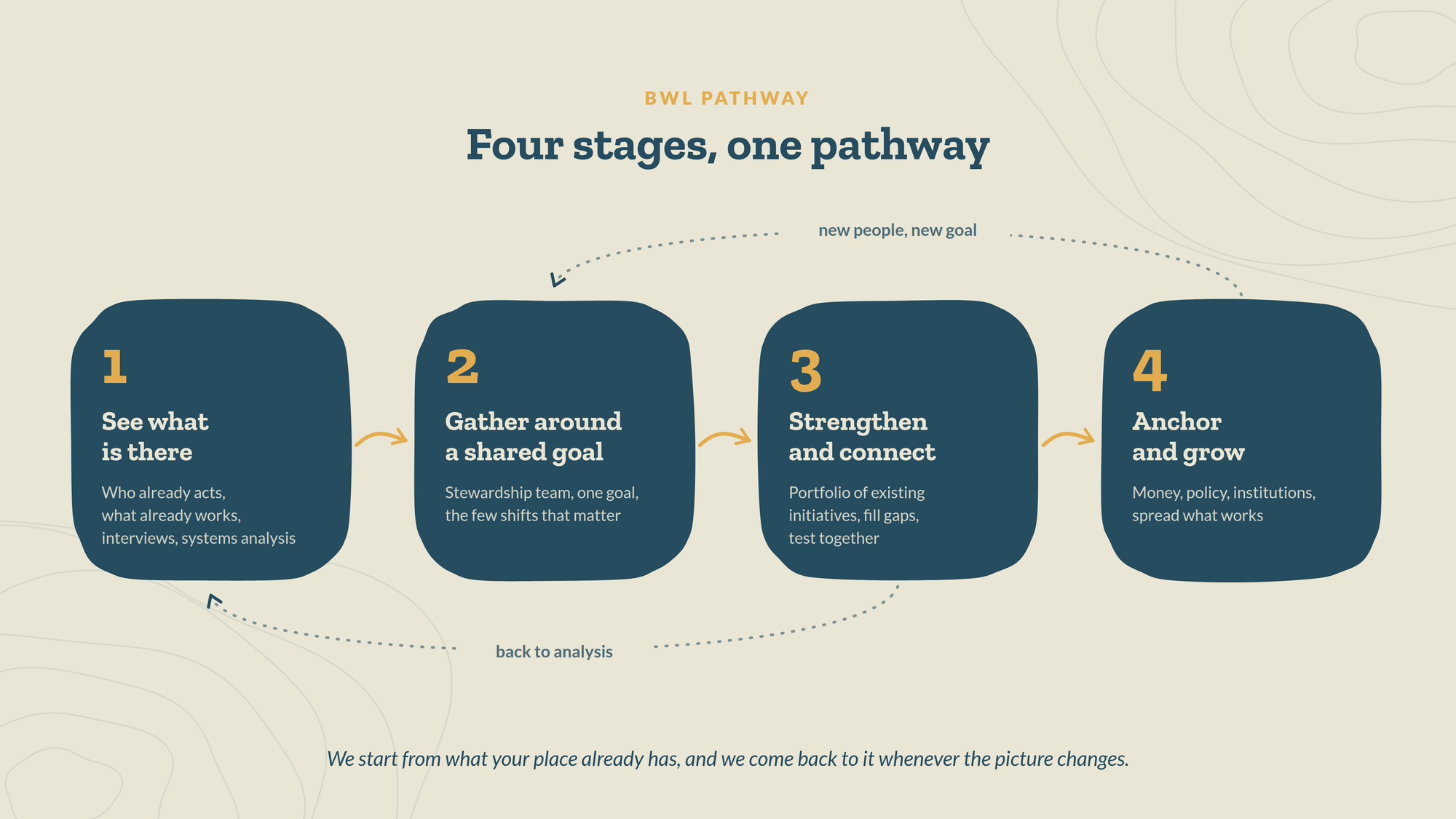
A weaving team is a group of people that connects people, projects, and places that are already alive and happening in one bioregion. They do activities like running multi-stakeholder collaboration processes, working with municipalities and mayors, or hosting spaces for collective intelligence to surface. They host spaces for citizens and different initiatives in the region to raise their voice and co-create the future. They map a portfolio of initiatives and help them work better together. They're developing financing mechanisms and work towards influencing policy. All to build a more resilient, place-based future.
The questions the teams had were plenty, and we gave space to them in the opening session:
- How can we be of service to people, land, river, and farmers?
- How do we stay motivated after 7+ years?
- How do you start a weaving team?
- How to weave without becoming the center?
- How to help people discover the beauty of their bioregion?
Lucas and I also took part as a team for the Cantabrian Sea Bioregion (I am doing both: support the BWL Support team on a European level and practice bioregional weaving locally) and we put forward the question:
- How can we weave the memory of our territory together with everything that is emerging today, and turn it into a lasting collective capacity to regenerate our bioregion?
You might ask, "Why do you start with questions?"
Because I have learned that questions you cannot answer are usually far better than the answers you cannot question.
In his book "Designing Regenerative Cultures", Daniel Christian Wahl explains the practice of living with the questions, because it goes against the tendency to have answers quickly. In the modern world, there are usually no easy answers, especially in complex systems that work on different social, economic, cultural, and ecological layers.
There are many takeaways and learnings and connections from this time together, and I would like to highlight a few personal reflections and share resources:
How do you listen to a river?
In the opening session, where every bioregion presented themselves and their bioregion, one moment struck me. Carla from the Fluvia River in Catalunya told us one thing they're doing is documenting the relationship of people to the river. They walked from the source to the sea and interviewed people along the way.
To me, that represents really well the practice of listening to the landscape and the people, what they need, how they relate, and what their wishes are before designing some solutions. This, for me, is one of the key practices of weaving.
How to weave without becoming the center?
This inspired reflection. Before, I thought of all the ways the Bioregional Weaving Labs needs to support the regions, and this was still a very centralized view of our organization. Looking back, I can see a metamorphosis happening over the last year to a more decentralized way of organizing. A change in how we can be of service to the broader field of bioregioning.
We are midwiving the infrastructure and shared spaces where decentralized connection can happen. We are providing tools, frameworks, and patterns that we have seen across regions. We facilitate spaces that help teams reflect and plan, but we are not prescriptive because each team, each region, is unique and knows best what is needed. We just support along the way with knowledge, inspiration, tools, funding, and networking to connect teams to relevant actors in the field.
Does African wisdom have a role to play in Europe?
Then there was Konkankoh present at the gathering. Konkankoh is an African elder from Cameroon and has built an internationally recognized eco-village there. He had to flee from Africa due to political persecution, and he landed in Europe. His question this week was whether African wisdom has a place in Europe.
This really shook me because the Western mainstream way of thinking is that Europe has all the answers and we need to transfer them to Africa for them to increase their prosperity. The assumption here is that we are right about our definition of prosperity, which is mostly about money, while the African idea of prosperity is more about healthy landscapes, food security, and a healthy community.
I think yes, African wisdom has a huge role to play, especially because we have eradicated most of our ancestral wisdom with mainland Europe. I think this describes very beautifully the solutions that already exist to the challenges we have as bioregions and as a continent.
He is currently building the African Peace Village in the South of Portugal and trains young refugees from Africa to take care of the land. Imagine a future where refugees can become ecosystem healers. Wouldn't that be great?
Governance is culture
Another main takeaway was that governance is culture. And it is so essential for grassroots initiatives that are decentralized and involve many actors.
"The road to hell is paved with good intentions" - Proverb
With my recent personal experience of failed governance in the Eco Village project, this speaks dear to my heart, and I'm so happy to have had Ernestine present, who ran a workshop on this.
Her advice:
- Keep governance playful and light. Nobody loves to endlessly discuss it, and at the same time, it's really important.
- In your initiatives, name the unspoken assumptions early when the team is growing, and see conflict as a call to co-create better governance.
- Start early, because once conflict arises and there's no good governance in place, things can get tricky.
She developed an amazing resource called the Governance Canvas together with Tijn, and I'm sharing it here.
Here's the link to the Governance Canvas on Tijn's Substack
Personally, for me, it comes at the best moment. While learning painfully how bad governance can hurt, I'm very sharply focusing on it while establishing a new association to hold all the bioregional work in our region.
Biohubs as catalyzer
Living in the city of Pollica for this gathering, with a castle as the hub from which the Future Food Institute runs weaving activities in the region, I had firsthand experience with how a local bioregional hub can serve as a catalyst for a whole region.
Pollica is actually one of the 10 case studies from the paper "Biohub: A Pathway to Regional Resilience" (from Metabolic and partners). Check it out at https://www.biohub.earth/
It's this physical place where you can convene people, learn, and bring together projects. For some regional hubs, this involves farming as well, or a retreat space, or hospitality. I'll keep it short here because I'm envisioning a whole edition on it in the future.
The need for telling more stories
If you're in a bubble, you don't know that you're in a bubble.
The regeneration movement is picking up pace and numbers, but we are still such a niche, and we need to be so many more. We are still underfunded and under-acknowledged while we hold an approach to solve the world's most pressing problems.
What I'm taking away is that we need to share more stories about our work.
Let's flood the space with more positive stories about the protopian future, the beautiful future that's already happening, but that's just not evenly distributed. To share stories of successful innovations in bioregions and the failures and learnings along the way. To share challenges and how we overcome them. To share useful tools and resources freely.
It encourages me to keep writing and sharing.
Happy regeneration,
Jonas
P.S.: If you are new to Bioregional Weaving and are curious. Here is a great resource to get started.

A Regenerative Life Newsletter
Join the newsletter to receive the latest updates in your inbox.
![10 Beliefs About the World That I Relearned in the Last 5 Years [#34]](https://images.unsplash.com/photo-1758685733627-683c357fe94e?crop=entropy&cs=tinysrgb&fit=max&fm=webp&ixid=M3wxMTc3M3wwfDF8c2VhcmNofDQyfHx1bmxlYXJuaW5nfGVufDB8fHx8MTc4MDU1ODA1Mnww&ixlib=rb-4.1.0&q=80&w=1460)
![On Preparing the Social Soil – Learning & Practices From Theory U [#33]](https://images.unsplash.com/photo-1625246333195-78d9c38ad449?crop=entropy&cs=tinysrgb&fit=max&fm=webp&ixid=M3wxMTc3M3wwfDF8c2VhcmNofDd8fHNvaWx8ZW58MHx8fHwxNzc5OTAwOTMyfDA&ixlib=rb-4.1.0&q=80&w=1460)
![Becoming a Bioregional Weaver – The Why, How It Started, and How It’s Going [#31]](https://images.unsplash.com/photo-1593671186131-d58817e7dee0?crop=entropy&cs=tinysrgb&fit=max&fm=webp&ixid=M3wxMTc3M3wwfDF8c2VhcmNofDl8fHdlYXZpbmd8ZW58MHx8fHwxNzc3NDUzNzA1fDA&ixlib=rb-4.1.0&q=80&w=1460)
