4 Paradigm Shifts We Need To Invite To Co-Create a More Beautiful Future [#39]
I think about the future almost every day.

Table of Contents
Over the past years, I've been learning to look at the future with a wide-boundary view: seeing how energy, ecology, the economy, and human behavior play together as one connected system.
Even though the future might look scary, I try to act from love for what's alive and good. I'm practicing mindfulness to stay present and find gratitude in the beauty of everyday life. I also try to look at the future from a humble perspective. I might be wrong in everything, and I'm learning every day.
What can we reasonably assume about the future from that wide-boundary view?
We know it will be systemically volatile (more on that in cultivating resilience in changing times). The stability of the past decades since World War 2 was based on the promise of endless economic growth, which is based mostly on fossil fuels, which will become less accessible in the future. Stable weather patterns are becoming more extreme. Geopolitical tensions arise from trying to capture the last bit of energy. AI will disrupt the labor market. And the list goes on.
We can assume that the future will be simpler, too, because all the complexity of a system that's based on dirt-cheap energy will begin to unravel once the fuel becomes expensive (as we see right now: the Strait of Hormuz, which normally carries about a fifth of the world's oil and liquefied gas, has been largely blocked since March, raising prices). The infrastructure of our economies is built for cheap fossil fuel-based energy. We will probably retire a lot of it and build new, more efficient systems.
The future will probably be more local, too. All of our international transport is based on fossil fuels. Fossil fuels are used to make the trains, the (electric) cars, and the gasoline and diesel that power trucks and boats that send goods all around the globe. My best guess is that we will switch back to horses at some point.
We won't be able to stop this species-level rite of passage. The only way out is through. If we do it right, I see an amazing life for more people on the horizon: one with less material and financial wealth but more social and ecological wealth (I wrote about what that trade felt like in a year of degrowth life).
These massive changes don't require some quick fixes in a faulty system. They require grand shifts in thinking and feeling: paradigm shifts that will help us on a species level to move towards the more beautiful future our heart knows is possible.
Paradigm Shift 1 - Changing the story we tell ourselves
Most humans operate from the paradigm of separation. They believe deep down that humans are separated from the rest of nature and that nature is something we must conquer, control, defeat, and exploit for our own comfort and protection.
This story encourages us to see ourselves as competitive individuals, separate from each other, battling it out in a zero-sum world against other life.
And the very qualities that we now know have been crucial for our evolution: kindness, compassion, cooperation, empathy, diversity, care, and humility, are seen as soft, weak, and as inhibitors to success.
But this story is wrong.
We are not separate from nature. We are interdependent.
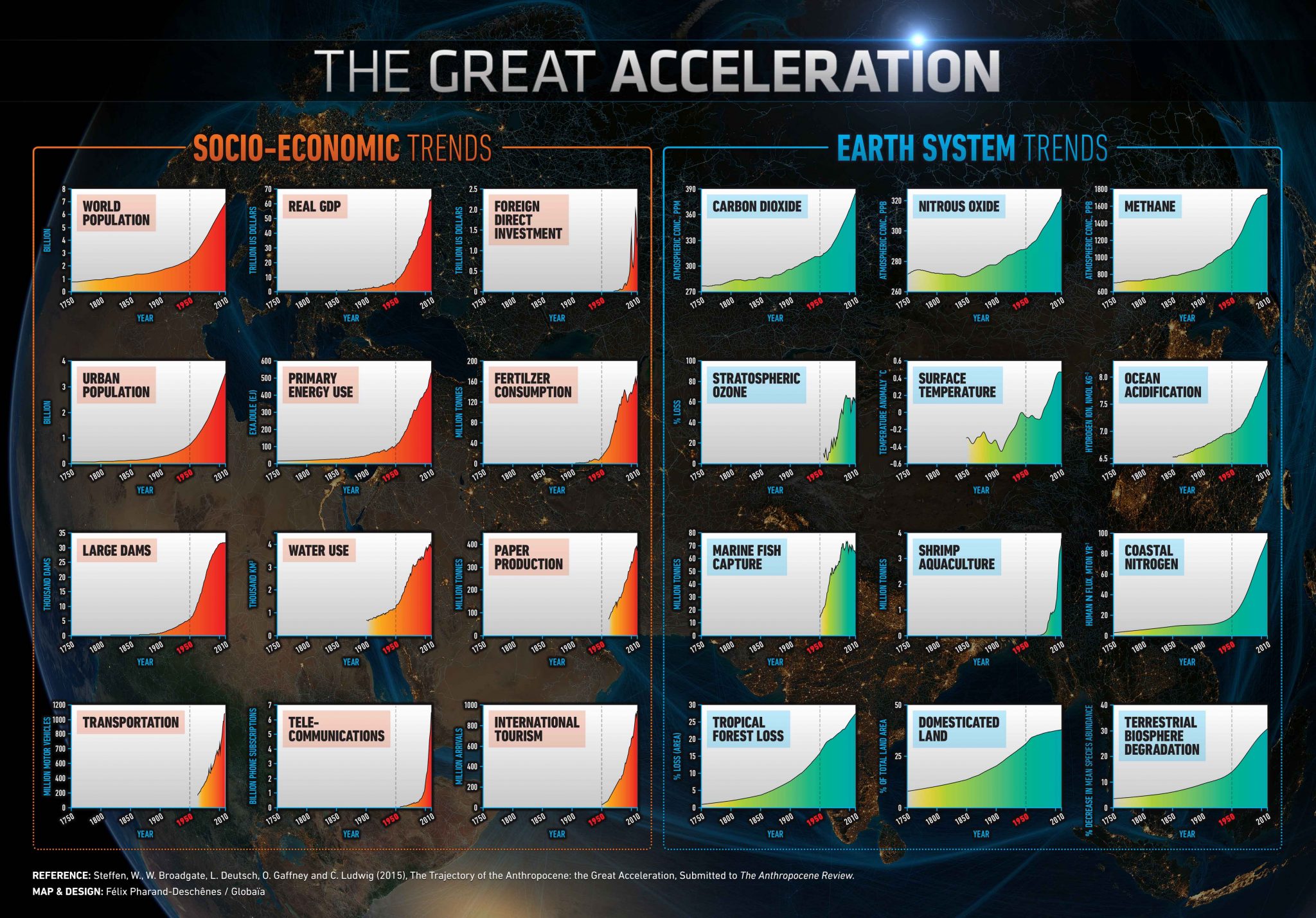
Source: International Geosphere- Biosphere Program
Human activity on Earth is now the main driver for change in Earth systems.
So let's change the story!
Let us widen our capacity to have compassion for the web of life, animals, watersheds, microorganisms. (People in my field call this the more-than-human world: every living being and living system beyond us humans.)
Let us understand that we have a role as a keystone species in this larger ecosystem. A keystone species is one that holds an ecosystem together, the way wolves keep deer from eating the whole forest.
We breathe air that was created by plants and phytoplankton.
We drink water that was purified by forests.
We eat food that was pollinated by insects.
Spending time in nature is a good activity to feel how connected we are.
Have you ever gone for a walk in the woods when you did not feel good and then came out feeling happier on the other side?
That's just one concrete example (more moments of deep connection here) to experience that connection and change our consciousness and paradigm of thinking.
Changing this mindset of separation to one of interconnection will change everything downstream.
Change of belief > change of habit > change of action.
Paradigm Shift 2 - Cultivating love for life
It's important to think critically: Why are we on this path towards a regenerative life?
Is it because we are afraid of the future?
Or is it because we fell in love with the future again?
When actions come from a place of fear or an anxious, activated nervous system, they might be short-sighted, egoistic, and not good for the wide-boundary well-being of the more-than-human world.
When actions come from a place of love, a grounded energy, a relaxed nervous system, they come from a place of care, kindness, and compassion. They nurture what wants to be born. They are more likely to support the more-than-human world from a holistic perspective.
Spending more time with plants and other life around you will change the story of separation to a story of connection.
Feeling connected can help us cultivate more compassion and love for life.
Cultivating love for life will give you energy when you feel down.
Love for life will help you transcend the fear.
Choosing love over fear is a practice.
It takes courage to stay present when despair would be easier. To speak when silence feels safer. To act when the outcome isn’t guaranteed. Fear asks us to shrink, to hand our agency over to outrage, exhaustion, or hopelessness.
Love requires that we remain available to one another, to responsibility, to the shaping of our shared world.
But courage is not an individual achievement. It’s contagious.
Every time one of us chooses consciously to show up, to speak clearly, to act with care, it makes that choice more visible and more possible for others. The more people who do this, the easier it becomes to do. This is how norms shift. - Unknown Source
Paradigm Shift 3 - Staying human in a world in crisis
On the journey of falling in love with the future and life again, it's worth asking the question: Why should we work towards a future where humans survive on planet Earth?
If you watch the news, you often see the darkest sides of humans: war, greed, hate, destruction of ecosystems.
It's easy to say that the world would be a better place without humans.
But that's a narrow-boundary view (the opposite of the wide-boundary view: judging one piece of the picture as if it were the whole). We are slaves to a system that brings out the worst in us. Where egoism pays off, and empathy and compassion can be taken advantage of.
But it's important to acknowledge: We have this amazing, innate capacity for empathy, compassion, care, and kindness.
Every time I notice this in others and in me, I am touched deeply. It's the spark that keeps hope alive.
We need to embody these positive traits of humanity. We need to choose humanity over barbarism. Wisdom over power. Love over hate.
"The question is no longer just how to succeed in the world. It is how to remain human in a time of unraveling, and how to become, in the deepest sense, both soulful and revolutionary: ruthless in understanding the material conditions of the age, yet still capable of love, grief, reverence, and fidelity to life. That task may require discipline and strength, yes, but also the harder, slower, less glamorous work of entering the landscape of the soul."
- By Brad Hornick
Paradigm Shift 4 - Reclaiming agency on a local level
Local food networks, local governance, local trust and relationships. These are things that any one of us can work towards, despite a system that's working against it.
We need to build genesis plots all around the world: places where a new way of living gets tried out first, so others can copy what works.
Call them bioregional learning centers (places where people learn about and care for their bioregion, the area shaped by a shared watershed, landscape and climate), regenerative villages (villages that give back more to their land and people than they take), or islands of coherence. That last term comes from an idea drawn from the work of the chemist Ilya Prigogine: when a complex system is far from balance, small, well-organized pockets inside it can shift the whole system.
The more of them, the better.
Save and protect what remains of old forests and biodiversity in your area and restore the ecosystems around you.
Plant the old-growth forests of the future.
Save seeds. (The revolution begins in the garden.)
Become an ecosystem engineer: a species that reshapes its habitat so more life can live there, the way beavers build dams that turn a stream into a wetland.
We won't be able to change the metabolism of the globalized economy - it will change on its own.
We need to protect the capacity for life to regenerate itself and regrow from there once the old system completely unravels.
It's not necessarily about creating solutions but rather recognizing nature has everything it already needs - we just need to learn how to stop destroying it.
Bioregional resilience (a region's ability to feed, house, and care for its people when supply chains break) is a key to a thriving, abundant future.
It starts with awareness and is followed by action.
What role will you play in creating the more beautiful world our heart knows is possible?
Happy regeneration,
Jonas
P.S.: If this sparked something in you, hit reply and tell me. Feel free to ask questions; I read every message & reply.
P.S.S.: Some more to read on this topic: What is the role of humans in the world, how I deal with climate emotions and active hope.

A Regenerative Life Newsletter
Join the newsletter to receive the latest updates in your inbox.


